Screen size
75 in
Screen size
Can a large-screen Mini-LED TV handle movies, sports, and modern console gaming without stepping up to an OLED? The 75-inch U6 Series pairs QLED color, local dimming, and a native 144Hz panel with Fire TV, making it a compelling all-around living-room choice. Its trade-off is that gaming bandwidth is limited to two of its four HDMI ports, and the Fire TV software can be finicky.
Choose this Hisense if you want a bright, colorful 75-inch picture, high-refresh gaming features, and built-in streaming in one set. Skip it if your priority is OLED-style dark-room contrast or a smart platform you never have to troubleshoot; the U6’s picture and feature mix are more persuasive than its software consistency.
| Screen size | 75 inches |
|---|---|
| Panel type | Mini-LED, QLED |
| Resolution | 4K |
| Refresh rate | 144Hz |
| Smart TV system | Fire TV |
| Local dimming | Up to 600 zones |
Up to 600 local dimming zones and peak brightness up to 1,000 nits are intended to separate shadow detail from bright HDR highlights.
That helps dramatic scenes and sports stand out, but the LCD backlight still does not deliver OLED’s pixel-level black control.
The native 144Hz panel, VRR, ALLM, and FreeSync Premium make this a more capable gaming screen than a basic 60Hz TV.
Only two HDMI ports are HDMI 2.1, so prioritize those connections for devices that need the higher-bandwidth route.
Fire TV puts streaming apps on a shared home screen, while Alexa voice control can help find content and manage basic tasks.
A built-in subwoofer adds bass without requiring a separate unit, but software freezes and connection hiccups are reported, so buyers who value a trouble-free interface above all should weigh that trade-off.
For a movie night in a dim room, the Mini-LED backlight and local dimming give dark scenes a useful contrast advantage over basic edge-lit sets, while Dolby Vision IQ and HDR10+ Adaptive cover major HDR formats. The screen is large enough to make the living room feel cinema-focused, but this is still a backlit LCD, not an OLED with self-lit pixels; buyers chasing the deepest possible blacks should take the OLED route instead.
Switch to a fast console game and the native 144Hz panel, VRR range of 48Hz to 144Hz, ALLM, and AMD FreeSync Premium give motion-focused play a stronger foundation than a standard 60Hz TV. The practical catch is port allocation: only two of the four HDMI ports are HDMI 2.1, so a console and another high-bandwidth device can use both. If several such devices are central to your setup, that constraint matters more than the headline refresh rate.
For daytime sports or a family show, the advertised peak brightness is up to 1,000 nits, and QLED color is designed to keep bright scenes and saturated uniforms lively. At 75 inches and 4K, the screen offers a large shared view, but no viewing-angle specification is provided; it is a safer fit for seating that faces the screen than for a wide room where viewers sit far off to the sides. Fire TV brings apps together on one home screen, though software glitches reported in some experiences make platform reliability a real consideration.
Community
The picture, brightness, and built-in sound are common reasons for satisfaction, while software freezes, app problems, and occasional connection friction are the main disappointments. The practical lesson is to judge the Fire TV experience as part of the purchase, not just the screen.
I upgraded from an older, more expensive Hisense and like the picture and features. Dolby Vision worked with my setup, and I found the TV sound usable, though a soundbar sounds better.
| Attribute | Hisense U6 Series Current | Hisense 85U6SF Pro | Hisense 75U7SG | Hisense 65S7SG CanvasTV |
|---|---|---|---|---|
| Price | $1,111.62 | $1,097.97 | $1,297.99 | $947.99 |
| Screen size | 75 inches | 85 Inches | 75 inches | 65 inches |
| Resolution | 4K | 4K | 4K | 4K |
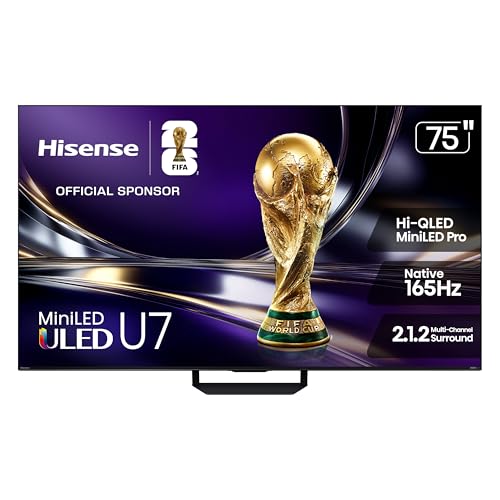
| Panel type | Mini-LED, QLED | - | MiniLED Pro with Hi-QLED (Quantum Dot Color) | - |
| Refresh rate | 144Hz | 144 Hz | 165 Hz | 144 Hz |
| Local dimming | Up to 600 zones | - | Up to 3000 local dimming zones | - |
| Editorial score | 82/100 | 91/100 | 95/100 | 91/100 |
Against the Samsung S90H, the U6’s Mini-LED and QLED route makes sense for a large living room where brightness, screen size, and gaming features share priority. The Samsung is the clearer alternative for a buyer specifically seeking OLED’s self-lit pixel approach; choose the Hisense when its 75-inch format and built-in Fire TV fit the room and routine better.
The LG OLED evo C6 is another 4K OLED alternative, with a 120Hz native refresh rate listed for that model. The Hisense offers a higher stated native refresh rate and Mini-LED local dimming, while the LG is the more direct choice for OLED-focused cinema viewing. For the U6, the deciding compromise is not just panel type: two HDMI 2.1 ports and Fire TV software behavior matter if your setup depends on several high-bandwidth devices or a consistently smooth smart interface.
Compare with
Add a second model to activate the direct comparison.
No products match that filter combination.
The U6 Series makes a strong case as a large, feature-rich living-room TV: 75-inch 4K, Mini-LED local dimming, QLED color, high-refresh gaming features, Fire TV, and a built-in subwoofer cover a lot of everyday ground. If that mix matches your room and devices, compare the current offer with OLED alternatives before deciding which picture trade-off matters more.
Skip it if you need OLED’s deepest blacks, more than two HDMI 2.1 connections, or a consistently trouble-free smart platform. For buyers who can live with those limits, the U6 is a versatile big-screen option; for buyers who cannot, the clearer route is an OLED TV or a model with a more suitable port and software setup.
Yes, the native 144Hz panel, VRR, ALLM, and FreeSync Premium suit high-refresh gaming, but only two HDMI ports are HDMI 2.1.
It supports HDR and local dimming for contrast, but buyers who put OLED-level blacks first should choose an OLED alternative.
Review published on